

 債券スクリーナー
 Excelアドイン
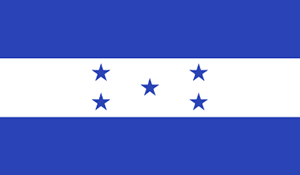
Honduras: 債券、インデックス、信用格付け
国名
ホンジュラス
信用格付
外貨建て
債券債務
6,205 百万 USD
最も包括的なデータベースを探索
1 000 000
債券
80 234
株
161 443
ETF&投資信託
70 000
インデックス
最も効率的な方法でポートフォリオを追跡
- 債券検索
- ウォッチリスト
- Excelアドイン

取引スケジュール 発行体マップ
クオート
/
/
/
個
個
個
- «
- 1
- ...
- {{ quotes.page - 2 }}
- {{ quotes.page - 1 }}
- {{ quotes.page }}
- {{ quotes.page + 1 }}
- {{ quotes.page + 2 }}
- ...
- {{ quotesLastPage }}
- »
情報プロバイダーから提供される引用符は参考値となります
プロフィール
|
From 2007 to 2012, the Honduran economy was driven primarily by private consumption and private investments and exports. Private sector consumption averaged 73.3% of real GDP in this period and private investment averaged 20.8% of real GDP. From 2007 to 2012, Honduras’ real annual GDP growth rate averaged 3.1% with the highest annual growth rate of 6.2% experienced in 2007. Honduras’ real GDP increased by 4.2% in 2008. Primarily due to the effects of the economic slowdown in the global economy, the Honduran economy contracted by 2.4% in 2009. In 2010 and 2011, however, the economy grew by 3.7% in each year. Based on initial estimates, real GDP grew by 3.3% in 2012. The 6.2% economic growth rate achieved in 2007 was primarily the result of increased exports, relatively low inflation and increased domestic consumption. During this period, increased employment and exchange rate stability contributed to increased economic activity. Economic contraction in 2009 resulted from weak external demand as a result of the Global Economic Crisis and the internal political unrest stemming from the removal of President Zelaya that year. During 2009, total fixed capital formation declined by 35.4% compared to 2008, resulting from a decrease of 38.6% in private sector investments.
Economic growth in 2010 and 2011 was the result of the recovery of consumption and investment, resulting from the renewal of international capital flows, as well as increased external demand that stemmed from the increased activity of foreign markets and trade partners, such as the United States, Europe, Central America and Mexico. The increased activity of foreign markets, in turn, lead to increased remittances from Honduran workers abroad and increased internal consumption, which at the same time resulted in stronger national employment. The stronger investment levels were associated with private construction, imports of capital goods and agro industrial expansion with increased exports. External debt consists mainly of loans obtained from various organizations and institutions such as the World Bank and the IADB. Internal debt is generally incurred through sovereign bonds placed in the domestic market and, to a lesser extent, loans from the national banking system. The Secretaría de Finanzas is responsible for managing the financial resources of the government as well as the administration and management of the public debt of the Central Government. As of December 31, 2012, Honduran indebtedness consisted of: (i) U.S.$2.7 billion (43% of total indebtedness) internal debt, primarily denominated in lempiras and (ii) U.S.$3.6 billion (57% of total indebtedness) external debt all of which is denominated in foreign currency (excluding quasi-fiscal debt). |
基本情報
-
組織名Ministry of Finance of the Honduras
-
組織ステータスOperating organization
-
サイト